General
In Kotlin, Everything is Object.
Any is root of all classes like java Object.
Unit is same as void of JAVA.
Nothing this is usually used to represent the return type of function which will always throw an exception.
0] Data Type:- Same like java, all are objects not primitive.
Byte, Short, Int, Long, Float, Double, String, Date, Char, Boolean
Default number variables are Int unless it crosses Int max limit.
Type check is done using "is" keyword
e.g. if (obj is String) {
return obj.length
}
'New' keyword not needed.
private, protected, internal(default in java) and public
In kotlin default scope is "public".
1] Variables :-
val for immutable variable declaration.
var for mutable variable declaration
e.g. val name : String = "abc"
Variables are mandatory to be initialized.
If want to assign null value then put "?" after type declaration
e.g. var dept : String? = null
Kotlin infers variable types, so variable type declaration is not mandatory
e.g. var fname = "ABC"
String comparison "=="
String formatting :-
val name = "hello"
println("$name world")
println("{$name.count()} world")
buildString() isnin built function for string builder.
const for constant.
== for equals comparison.
=== for reference comparison.
Explicitly getter, setter method can be defined for custom behaviour.
var interestRate : Int = 0
    set(value) {
        if (value > 3)
            field = value
    }
val isEmpty: Boolean get() = this.size == 0
field is internal variable available.
2] Control Flow :-
If Else If Else are same like java
Instead of "switch", Kotlin has "when".
In "when" instead of "default" it uses "else".
"if", "when", "try/catch" can be used to assign values to a variable.
e.g. val dept = if (name != null) "hi" else "hello"
vale dept = when(name) {null -> "hello" else -> "hi"}
Ternary operator are not supported as same can be achieved with if <expr> else <expr> in one line
3] Function :-
Syntax is fun <function_name> : <return_type> {
}
for VOID function it is ": Unit".
Return types are mandatory except VOID. Function return types are not inferred.
"if", "when", "try/catch" can be used to assign values to a function.
Function parameter can have default values.
Overloading of function is same as java.
Extension functions :- To declare an extension function, prefix its name with a receiver type, which refers to the type being extended. Extensions are resolved statically.
fun String.mask(value : String) : String {
    return "abcde"
}
Extension properties :-
val <T> List<T>.lastIndex: Int get() = size - 1
Initializers are not allowed for extension properties.
Companion objects can also have extension functions.
Scope of extension function:- In most cases, define extensions on the top level, directly under packages. To use an extension outside its declaring package, import it at the call site.
Recursive function - tailrec makes computation of result in each step so there is no stack overflow, it acts as loop. But if it is not used tailrec then result is calculated in the end but if may cause stack overflow.
A higher-order function is a function that takes functions as parameters, or returns a function.
val ss : (Int, Int) -> Int = { a: Int, b : Int -> a + b }
Function can be called as f.invoke or f()
e.g. ss.invoke(12, 34) or ss(12,34) // can be denoted as ::
Named arguments. -- function with many parameter can be called by passing parameter name.
it: implicit name of a single parameter
4] Loop :-
For loop syntax is similar to python.
for (i in 1..100) { ... } // closed range: includes 100
for (i in 1 until 100) { ... } // half-open range: does not include 100
for (x in 2..10 step 2) { ... }
for (x in 10 downTo 1) { ... }
if (x in 1..10) { ... }
while, do - while is similar to java
break, return supports label
loop@ for (i in 1..100) {
for (j in 1..100) {
if (...) break@loop
}
}
4] classes :-
All classes are default final, it can't be inherited.
e.g. class myClass
To make a class inheritable, mark it with the open keyword.
open class Base(p: Int)
class Derived(p: Int) : Base(p)
A class in Kotlin can have a primary constructor and one or more secondary constructors.The primary constructor is part of the class header:
class Person constructor(firstName: String) { /*...*/ }
class C private constructor(a: Int) { ... }
By default constructor is public. Constructor parameters are by default val.
The primary constructor cannot contain any code. Initialization code can be placed in initializer blocks, which are prefixed with the init keyword.
During an instance initialization, the initializer blocks are executed in the same order as they appear in the class body, interleaved with the property initializers:
If the class has a primary constructor, each secondary constructor needs to delegate to the primary constructor, either directly or indirectly through another secondary constructor(s).
If a non-abstract class does not declare any constructors (primary or secondary), it will have a generated primary constructor with no arguments. The visibility of the constructor will be public.
To override method & properties use 'open' prefix for method & property in parent class & use 'override' keyword in child class.
'lateinit' allows initializing a not-null property outside of a constructor
@JvmOverloads is used when overloading method to be used in Java. As in Kotlin function has default parameter but java doesn't support.
Sealed classes and interfaces represent restricted class hierarchies. No other subclasses may appear outside a module within which the sealed class is defined.
enum classes can't extend a sealed class (as well as any other class), but they can implement sealed interfaces.
Generics : Classes in Kotlin can have type parameters, just like in Java.
Kotlin doesn't have wildcard. Kotlin supports declaration site variance.
Type parameter T is not INPUT in any method.
interface Source<out T> { fun nextT(): T}
Type parameter T is not OUTPUT of any method.
interface Comparable<in T> {
operator fun compareTo(other: T): Int }Object Expression, Object declaration, Companion object
Nested and inner classes - interface can be used with inner classes. Inner classes carry a reference to an object of outer class. Anonymous inner class instances are created using an object expression.
Sealed classes let you restrict the use of inheritance. Once you declare a class sealed, it can only be subclassed from inside the same package.
Inline classes - To declare an inline class, use the value modifier before the name of the class. To declare an inline class for the JVM backend, use the value modifier along with the @JvmInline annotation before the class declaration.
by-clause in the supertype list for Derived indicates that b will be stored internally in objects of Derived and the compiler will generate all the methods of Base that forward to b.Delegated properties :-
Lazy properties: the value is computed only on first access
Type Aliases :-
Operator overloading:- To implement an operator, provide a member function or an extension functionwith a specific name for the corresponding type.
operator fun Point.unaryMinus() = Point(-x, -y)
Null Handling :-
var b: String? = "abc"
Safe calls ( ?. )
val b: String? = null
println(b?.length)
Safe call operator ?. doesn't execute function if it is null. it returns null instead of throwing exception.
e.g. bob?.department?.head?.name
if in above bob or department or head is null it returns null
Elvis operator ( ?: ) (If-not-null-else shorthand):
val l : Int ?= null
println(l?.toString() ?: "error")
The !! operator
Safe Casts
ClassCastExceptionval aInt: Int? = a as? IntCollections of a nullable type
This expressions
Collection Types
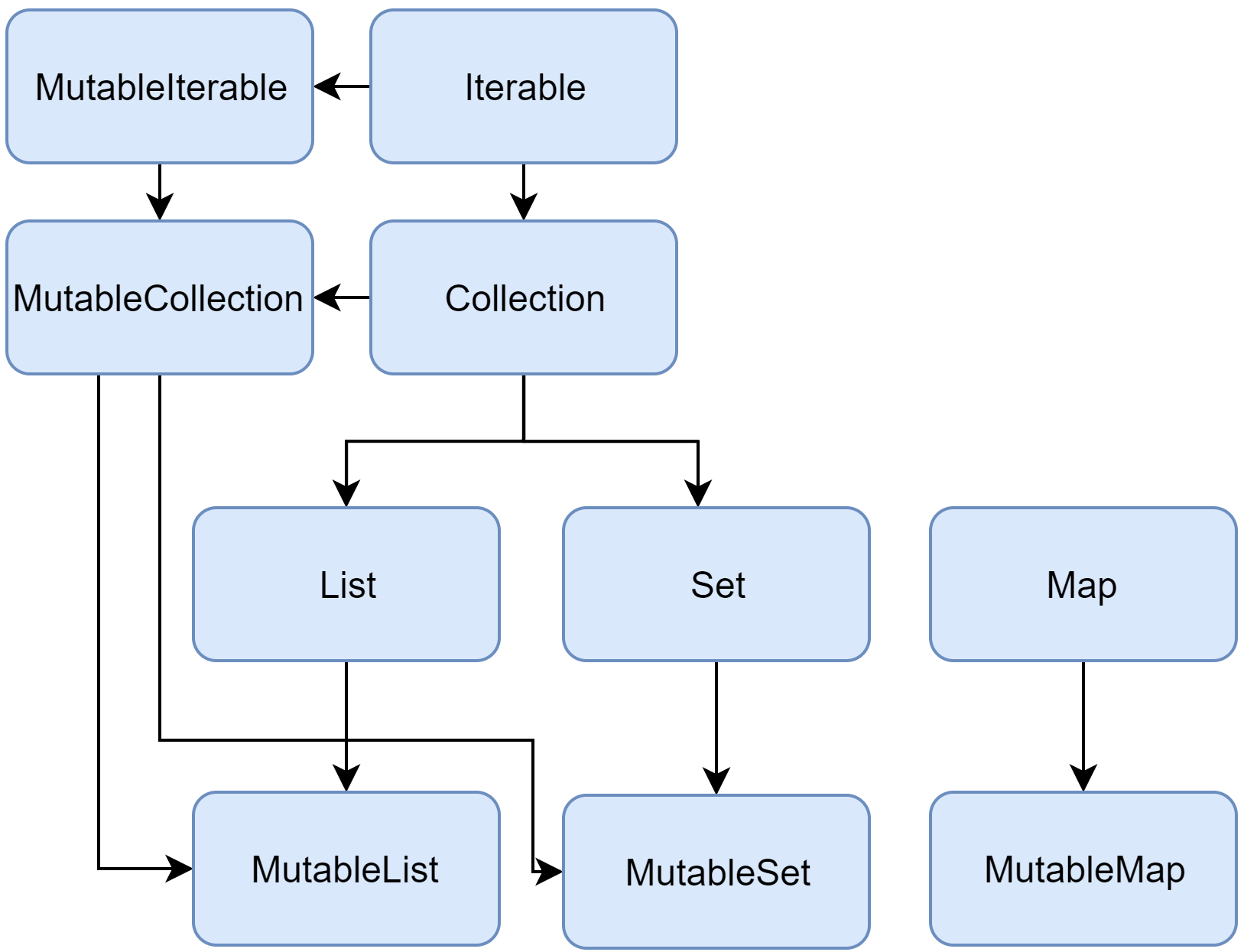
The default implementation of MutableSet – LinkedHashSet – preserves the order of elements insertion.HashSet order is not guaranteed.Function | Object reference | Return value | Is extension function |
|---|---|---|---|
| Lambda result | Yes | |
| Lambda result | Yes | |
- | Lambda result | No: called without the context object | |
| Lambda result | No: takes the context object as an argument. | |
| Context object | Yes | |
| Context object | Yes |
use keyword is for autoclosable of resource.
== for structural comparison and === for referential comparison.a == b compiles down to if (a == null) b == null else a.equals(b).condition ? then : else in Kotlin. Instead, if may be used as an expression: e.g. fun max(a: Int, b: Int) = if (a > b) a else b
No comments:
Post a Comment